Welcome to the Circle of Trust!

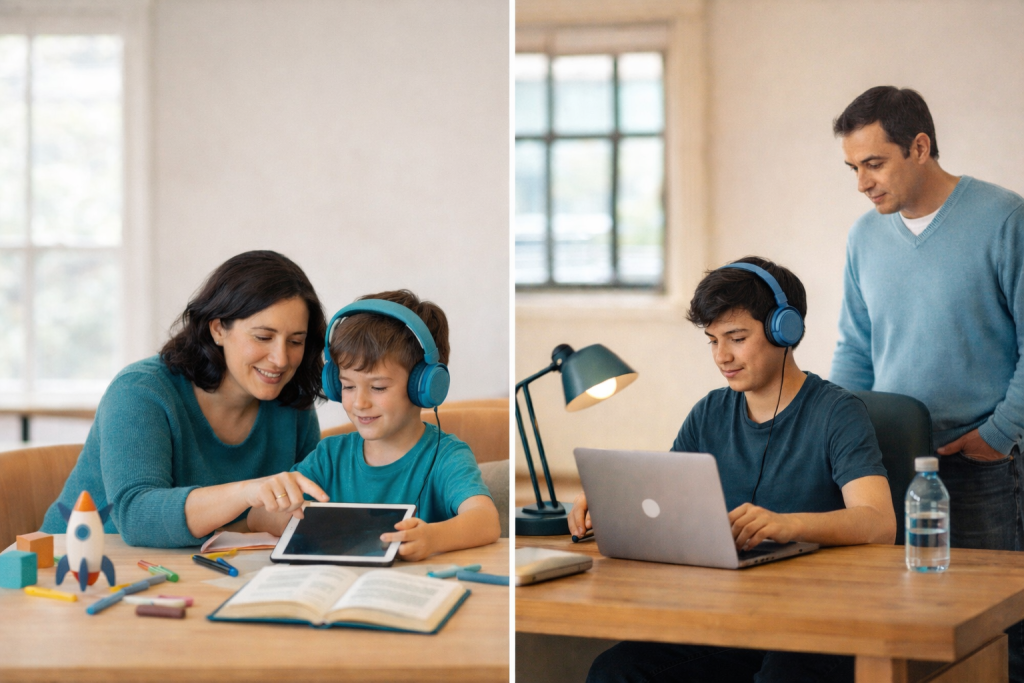
Online learning can work. It can also feel like trying to run a school, an office, and a snack shop from the same kitchen table.
If it feels harder than expected, that is because it is.
Here are simple recommendations for parents that actually help.
A simple way to think about it:
One is in the seat next to them. The other is not on the plane, but still helping prevent disaster.
Kids do better with a simple rhythm:
Pressure is like pressing harder on the gas when the car is stuck in mud.
Structure is like putting the car back on the road.
Online learning goes better when the day feels predictable, calm, and not like a surprise attack at 8:03 a.m.
Your job is to help your child learn how to learn.
That looks like this:
Build the scaffolding, but do not become the whole building.
Because if you are correcting every answer, reminding every second, and rescuing every wobble, your child may finish the lesson but miss the skill.
A stressed child does not learn well.
A scared child does not focus well.
A child who feels safe is much more likely to stay engaged.
So before fixing the math, fix the mood.
Helpful phrases:
Think of the brain like Wi-Fi.
When emotions are storming, the signal gets weak.
Connection first. Then download the lesson.
Try to notice:
Do not only focus on the grade. Focus on how your child got there.
A good grade is nice.
But learning to keep going after frustration is gold.
Grades are the selfie. Effort and strategy are real life.
You do not need to figure everything out alone.
When something feels confusing, heavy, or off track, reach out.
Stay connected about:
Think of it like a group project.
Home and school work much better when they stop guessing and start talking.
Too much screen time, especially late at night, can spill into sleep, mood, and focus.
Helpful basics:
A tired child trying to do online learning is like you trying to answer emails at 2 a.m. while eating chips in the dark.
Possible, yes. Ideal, no.
Online learning is hard for many families.
Parents are often juggling:
So if you have ever thought:
You are not alone. This does not mean you are failing.
It means you are parenting in real life, not in a perfect Pinterest classroom with matching baskets and a lavender diffuser.
Be a guide, not a police officer.
Be present, not overbearing.
Be calm, clear, and consistent.
Help your child build learning habits, not just finish tasks.
Online learning works better when children have:
Do not try to be the whole school. Be the safe base, the steady coach, and the snack provider.
Reflect a little:
When your child struggles with online learning, do you usually move into pressure, rescue, or calm support?
What is one small change you could make this week to bring more rhythm and less tension into your home?